
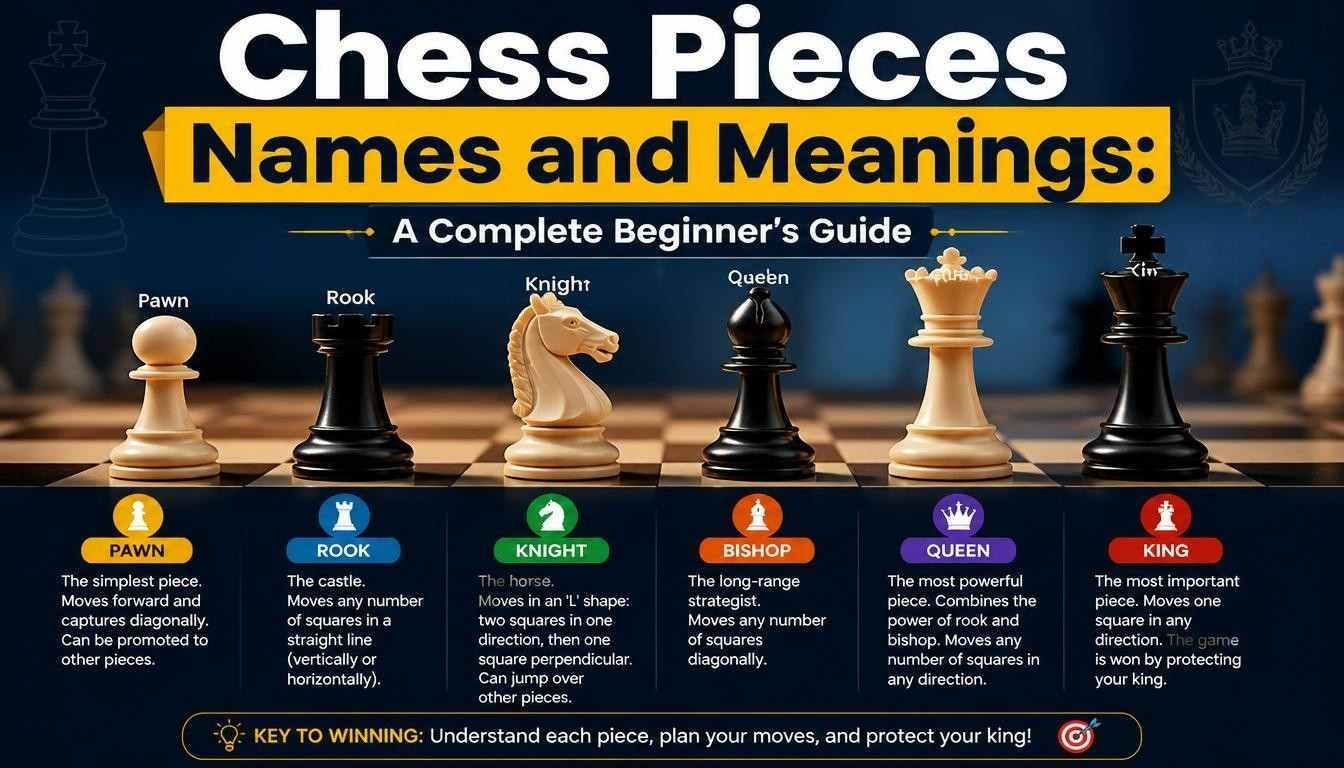
Learning chess starts with a simple but confusing question: what are all those pieces actually called? New players often mix up bishops and knights, forget where the queen belongs, or wonder why a rook is sometimes called a castle.
This guide covers chess pieces‘ names in plain language, from the king and queen down to the eight pawns on the front row. You’ll see how each piece moves, where it starts, and the letter it uses in chess notation.
You’ll also get a quick-reference table, setup tips, and answers to the mix-ups that trip up most beginners. By the end, you’ll recognize every piece on sight and understand how they work together on the board.
Table of Contents
Chess Pieces Names at a Glance
This quick-reference table lists every chess piece name, how many each side starts with, the notation letter used in game scores, the standard point value, and the squares where they begin on the board.
| Piece | Count per Side | Notation | Point Value | Starting Squares (White / Black) |
| Bishop | 2 | B | 3 | c1, f1 / c8, f8 |
| King | 1 | K | Invaluable | e1 / e8 |
| Knight | 2 | N | 3 | b1, g1 / b8, g8 |
| Pawn | 8 | (none) | 1 | a2–h2 / a7–h7 |
| Queen | 1 | Q | 9 | d1 / d8 |
| Rook | 2 | R | 5 | a1, h1 / a8, h8 |
Types of Chess Pieces and How They Move

A standard chess set contains 32 pieces total, with 16 per side. These 16 consist of six distinct types: one king, one queen, two rooks, two bishops, two knights, and eight pawns. The term “piece” often excludes pawns, but every unit moves differently. The king moves one square in any direction, while the queen combines rook and bishop movement, sliding any distance along ranks, files, or diagonals.
Rooks travel horizontally or vertically, bishops stay on their starting color along diagonals, and knights jump in an L-shape. Pawns advance forward but capture diagonally, with optional two-square first moves and promotion at the far rank.
Pro Tip:
When learning piece movement, set up only the king, queen, and a few pawns to practice how each unit’s range changes on an open board versus a crowded one.
1. The Pawn
The pawn is the most numerous chess piece, with each player starting with eight. Pawns move one square forward but capture one square diagonally. On their first move, they may advance two squares if both are empty. A pawn reaching the opponent’s back rank must promote to a queen, rook, bishop, or knight.
2. The Rook
Each player has two rooks, which start in the corner squares: a1 and h1 for White, a8 and h8 for Black. A rook moves any number of unobstructed squares in a straight line, either horizontally or vertically. The piece is also commonly called a “castle,” a nickname tied to its tower-like shape and its role in the castling move.
3. The Knight
Each side starts with two knights, placed on b1 and g1 for White and b8 and g8 for Black, directly beside the rooks. A knight moves in an L-shape: two squares in one direction, then one square perpendicular. It is the only chess piece that can jump over other pieces, making it especially useful in crowded positions.
4. The Bishop
Each player starts with two bishops, placed on c1 and f1 for White and c8 and f8 for Black. A bishop moves diagonally any number of unobstructed squares. Because it never changes direction off its diagonal, each bishop stays on one color for the entire game, and it cannot jump over other pieces.
5. The Queen
Each side has one queen, starting on d1 for White and d8 for Black. The queen combines the movement of the rook and bishop, sliding any number of unobstructed squares along ranks, files, or diagonals. Its placement follows a simple memory aid: the queen sits on her own color, so White’s queen starts on the light d1 square and Black’s on the dark d8 square.
6. The King
Each player has one king, starting on e1 for White and e8 for Black. The king moves one square in any direction, but it can never move into check. When the king is attacked and cannot escape, the position is checkmate and the game ends. Because its loss decides the game, the king carries no point value.
How to set up a chessboard
Place the board so a light square sits in each player’s bottom-right corner. On the back rank, arrange pieces from left to right as rook, knight, bishop, queen, king, bishop, knight, rook. The queen always starts on her own color: white queen on the light d1 square, black queen on the dark d8 square.
All eight pawns fill the rank directly in front. The vertical columns are files, labeled a through h, and the horizontal rows are ranks, numbered 1 through 8.
Pro Tip:
Double-check the queen’s square before play begins, since swapping the king and queen is the most common setup error and can invalidate castling later.
Chess Piece Values: Which Ones Matter More?
These point values offer a rough guide to comparing chess pieces, but they are not official rules. Use the table to judge trades and material balance, keeping in mind that piece activity and position often matter more than raw numbers .
| Piece | Point Value | Notes |
| Pawn | 1 | Value rises sharply near promotion |
| Knight | 3 | Roughly equal to a bishop in most positions |
| Bishop | 3 | The bishop pair is often worth slightly more than 6 total |
| Rook | 5 | Stronger than a minor piece, weaker than a queen |
| Queen | 9 | Most powerful piece in standard play |
| King | No standard value | Its loss ends the game, so it is not traded |
Chess Piece Names, Nicknames, and Notation Letters
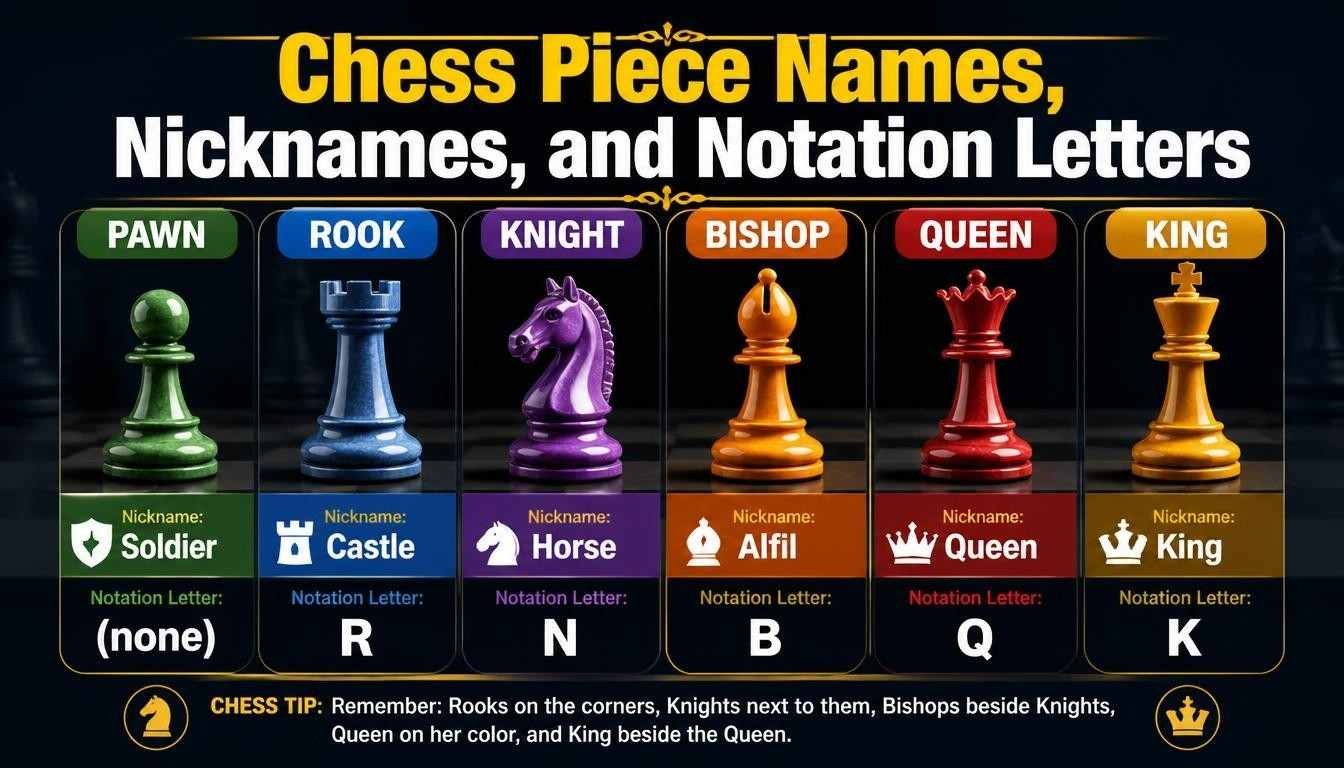
Chess pieces carry standard names, informal nicknames, and single-letter notation codes, with origins that often trace back through Persian and Arabic terms. These names help players describe positions clearly and understand the game’s history.
- King (K)
- Queen (Q)
- Rook (R)
- Bishop (B)
- Knight (N)
- Pawn (no letter)
- Castle (Rook nickname)
- Tower (Rook alternate)
- Fortress (Rook alternate)
- Horse (Knight nickname)
- Cavalier (Knight alternate)
- Springer (Knight German-derived)
- Bish (Bishop informal)
- Fou (Bishop French, “jester”)
- Runner (Bishop German-derived)
- Elephant (Bishop historical)
- Alfil (Bishop Spanish, from Arabic)
- Minister (Queen historical)
- Vizier (Queen Arabic-derived)
- Lady (Queen alternate)
- Dame (Queen French-derived)
- Shah (King Persian)
- Raja (King Sanskrit-derived)
- Wazir (Queen Persian)
- Rukh (Rook Persian)
- Roc (Rook alternate)
- Marquis (Knight historical)
- Cornu (Knight Latin alternate)
- Archer (Bishop historical)
- Jester (Bishop alternate)
- Officer (Bishop Greek-derived)
- Camel (Bishop alternate)
- Soldier (Pawn nickname)
- Foot Soldier (Pawn descriptive)
- Peon (Pawn Spanish-derived)
- Bauer (Pawn German)
- Pion (Pawn French-derived)
- Pedone (Pawn Italian)
- Pešak (Pawn Slavic)
- Sarbaz (Pawn Persian)
- Asb (Knight Persian)
- Fil (Bishop Arabic/Persian)
- Top (Rook Turkish)
- Navak (Rook Armenian)
- Konj (Knight Slavic)
- Lovac (Bishop Slavic)
- Skakač (Knight Slavic alternate)
- Turn (Rook Romanian)
- Nebun (Bishop Romanian)
- Cal (Knight Romanian)
Special Moves in Chess
Three special moves break the normal rules of chess piece names and movement. Castling lets the king and a rook move together once per game under strict conditions. En passant allows a pawn to capture a pawn that just advanced two squares. Promotion turns a pawn reaching the far rank into a queen, rook, bishop, or knight.
Pro Tip:
Learn the exact conditions for castling early, since moving your king or rook even once permanently removes the option.
Common Mix-Ups When Learning the Pieces
Beginners often confuse a few basic rules. Knights sit beside the rooks on the back rank, not between bishops, and they are the only pieces that jump. Bishops cannot jump and stay on one color forever. “Castle” is a nickname for the rook, while castling is a separate move. And the queen always starts on her own color.
Pro Tip:
Set up the board once from a labeled diagram before playing, since fixing placement errors early prevents confusion later.
FAQ’s
What are the names of the chess pieces?
A standard chess set includes six piece types: king, queen, rook, bishop, knight, and pawn. Each player starts with one king, one queen, two rooks, two bishops, two knights, and eight pawns.
How many of each chess piece are there?
Each player begins with sixteen pieces: one king, one queen, two rooks, two bishops, two knights, and eight pawns. Across both sides, a full set contains thirty-two pieces in total.
Which chess piece is the strongest?
The queen is generally considered the strongest piece because it combines the movement of both the rook and bishop. It can slide any distance horizontally, vertically, or diagonally across the board.
Which chess piece can jump over others?
The knight is the only piece that can jump over other pieces. It moves in an L-shape and leaps over any pieces in its path to reach its destination square.
Is the rook the same as a castle?
Yes, “castle” is a common informal nickname for the rook. The piece’s tower-like shape inspired the name, though “rook” remains the standard term used in official chess rules and notation.
What letters represent chess pieces in notation?
In English algebraic notation, pieces use capital letters: K for king, Q for queen, R for rook, B for bishop, and N for knight. Pawns have no letter and are identified by the destination square alone.
Where does each piece start on the board?
White pieces sit on ranks one and two; black pieces mirror them on ranks seven and eight. Rooks occupy the corners, knights sit beside them, bishops next, then the queen on her color, and the king beside her.
Conclusion
Every chess game starts with the same 32 pieces, and knowing their chess pieces names gives you a solid foundation for everything that follows. Once you can identify the king, queen, rooks, bishops, knights, and pawns on sight, movement rules, notation, and point values start to make sense.
The setup details matter more than beginners expect. Placing the queen on her own color, keeping knights beside the rooks, and remembering that only knights jump will save you from the mix-ups that slow so many new players down.
Before your next game, set up the board slowly and check each square against the table. That small habit builds the pattern recognition you need, and soon the whole board will feel familiar.
3 thoughts on “Chess Pieces Names and Meanings: A Complete Beginner’s Guide ”